What is the smallest version of this that still counts as done?
Write like you are explaining this to a friend who is on your side.

ADHD-friendly prompts for distraction, overwhelm, task paralysis, emotional spirals, and noticing what helps your brain work better.
What is the smallest version of this that still counts as done?
Write like you are explaining this to a friend who is on your side.
A single question in your inbox each week. No account, no streak to protect, unsubscribe whenever.
This page is designed to be low-pressure and usable on hard days. The prompts are short, specific, and built around self-awareness rather than self-judgment.
Grouped by the friction they are for. Tap any one to load it into the writing box at the top of the page.
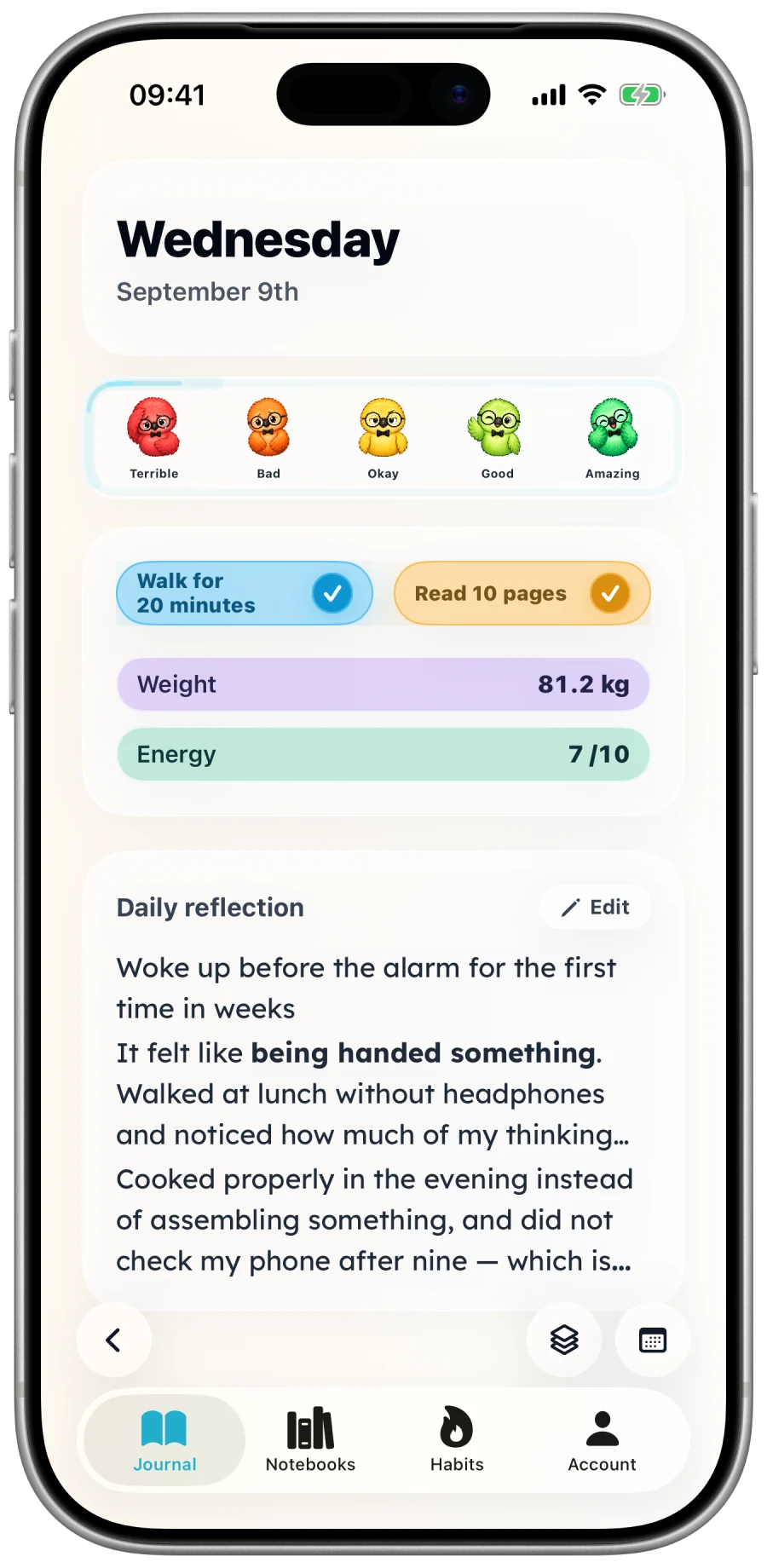
Three Cells is where the writing goes when you want to keep it — rate the day, track a habit, see patterns.
The questions here are written from scratch, but most are built on a framework someone else worked out first. The starting point is James Pennebaker's expressive writing research, which found that writing about a difficult experience for 15 to 20 minutes across a few sessions produced measurable changes in wellbeing. The practical rule that follows: keep writing, and do not stop to repair the sentences.
Yes. They are written for adult ADHD friction like task initiation, shame, overload, work demands, and inconsistent energy.
Keep the sessions short, use one prompt at a time, and end with a tiny action. Consistency usually improves when the routine feels lighter.
Track friction points, what helped your focus, emotional patterns, energy, and the conditions that made tasks easier or harder to start.
Shorten everything. Write one prompt at a time rather than facing a blank page, keep sessions to a minute or two, and let entries be fragments instead of paragraphs. Attaching the entry to something you already do daily gives it a cue to hang on, which matters more than picking the right time of day. If you miss a week, start again at the next entry rather than rereading everything you skipped.
Journaling does not treat ADHD, and it is not a substitute for diagnosis, medication, or therapy. What it can do is move things out of working memory and onto a page, which is where a lot of ADHD friction sits. Written entries also make patterns visible over weeks that are hard to hold in your head, such as which conditions make starting easier. Treat it as a support, not a fix.
It means writing two or three lines in the gap between tasks: what you just finished, and what you are picking up next. The pause acts as a transition marker, which can help when switching tasks tends to lose the thread. It suits ADHD partly because the entries are tiny and tied to a moment that already exists in your day.
Same generator, tuned for a different kind of entry.
 Answer it here