Context Crisis: How to Stop Context Switching and Recover Deep Focus
Most people are not short on time. They are short on uninterrupted attention.
The modern workday is a loop of app switching: tasks in one tool, notes in another, journaling somewhere else, habits in a fourth place. You stay busy all day and still end the day feeling behind.
That is the context switching crisis.
The hidden tax of toggling
Every switch between tools has a cognitive cost:
- You disengage from the current task.
- You reorient to a new interface.
- You rebuild momentum.
When this repeats all day, deep work never starts. You get stuck in constant reorientation.
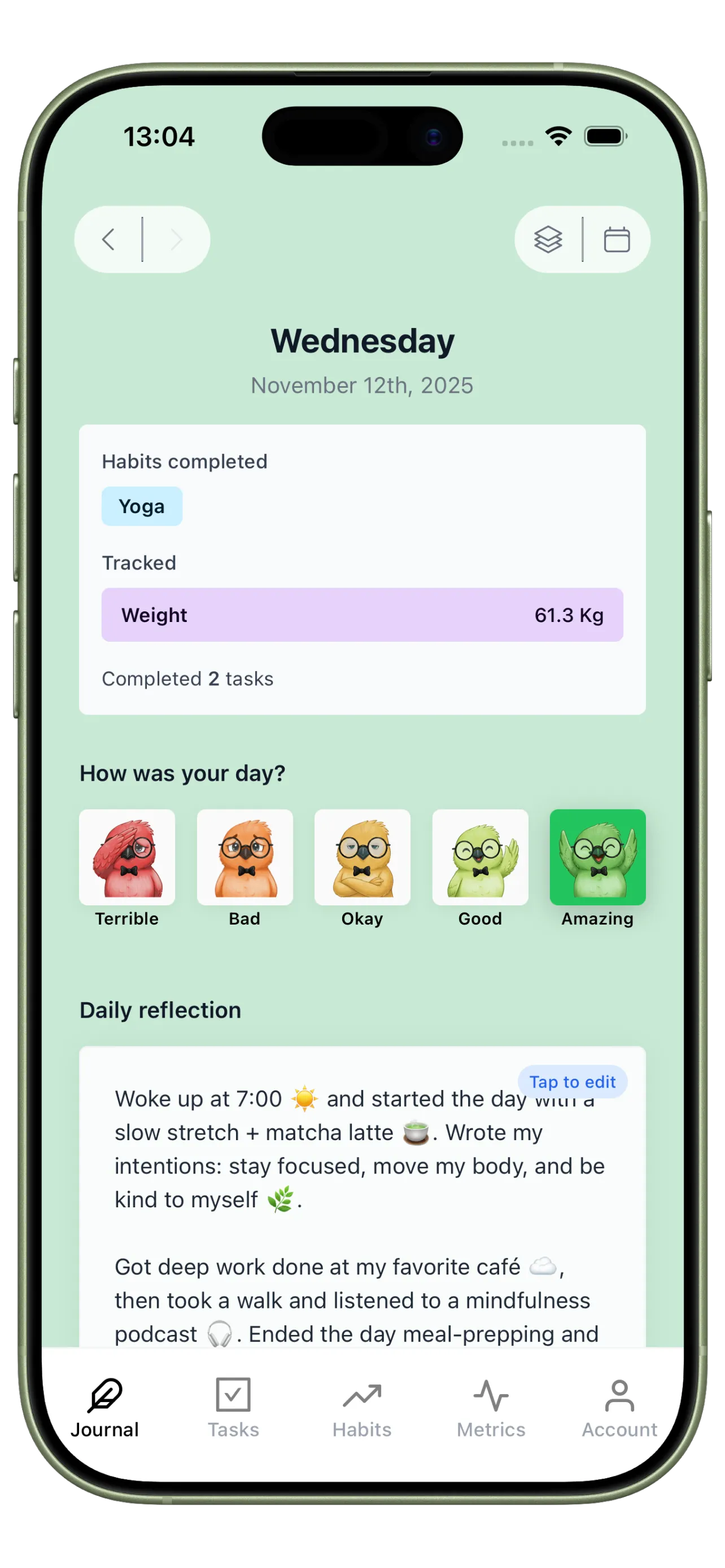
People join Three Cells to get more energy, confidence, structure, and peace of mind. The app turns that intent into a simple daily system you can actually stick to.
Attention residue is the real enemy
After each switch, part of your mind stays attached to the previous task. This is called attention residue.
You might be looking at your current screen, but mentally you are still in the previous context. Quality drops. Decision speed drops. Creativity drops.
If you feel scattered by 2 PM, this is usually the reason.
Why "one home base" works
A one-home-base workflow keeps your daily context in one place. In Three Cells, your tasks, notes, metrics, and reflections are anchored to the same date.
That structure reduces the need to jump between tools just to answer:
- What did I finish?
- What did I learn?
- What should I do next?
One timeline means fewer context reloads and more contiguous focus.
See your whole day in one place

Busy vs productive
Busy work is reactive. Productive work is intentional.
A busy day usually looks like:
- Constant notifications.
- Rapid task switching.
- Zero protected focus windows.
A productive day usually looks like:
- Fewer priorities.
- Scheduled deep work blocks.
- Deliberate asynchronous communication.
The difference is not effort. It is cognitive architecture.
The Focus Window protocol
Use this daily protocol to reduce switching:
- Pick one strategic task for the first block of the day.
- Silence nonessential notifications for 60-90 minutes.
- Keep all related notes and decisions inside the same daily page.
- Log completion and next step before you switch contexts.
- Review the day in a short evening reflection.
This protects flow and creates cleaner handoffs between tasks.
Consolidation beats optimization
Most people try to optimize each app separately. That usually makes fragmentation worse.
Start with consolidation:
- Fewer tools.
- Fewer tabs.
- Fewer context shifts.
Then optimize your process inside one system.
Final thought
You do not need a more complicated productivity stack. You need less switching.
If your tools force your brain to reload context all day, your system is broken. Consolidate your workflow into a daily home base, protect focus windows, and let your attention work at full strength again.