Cognitive Reflection: How AI-Guided Journaling Improves Focus and Decision Making
Most people do not fail journaling because they are lazy. They fail because the blank page gives no direction.
You open your journal, write three vague lines, and close it. Nothing changes.
That is where cognitive reflection is different. Instead of treating journaling as a diary, you treat it as a structured review system that improves the way you think, decide, and act.
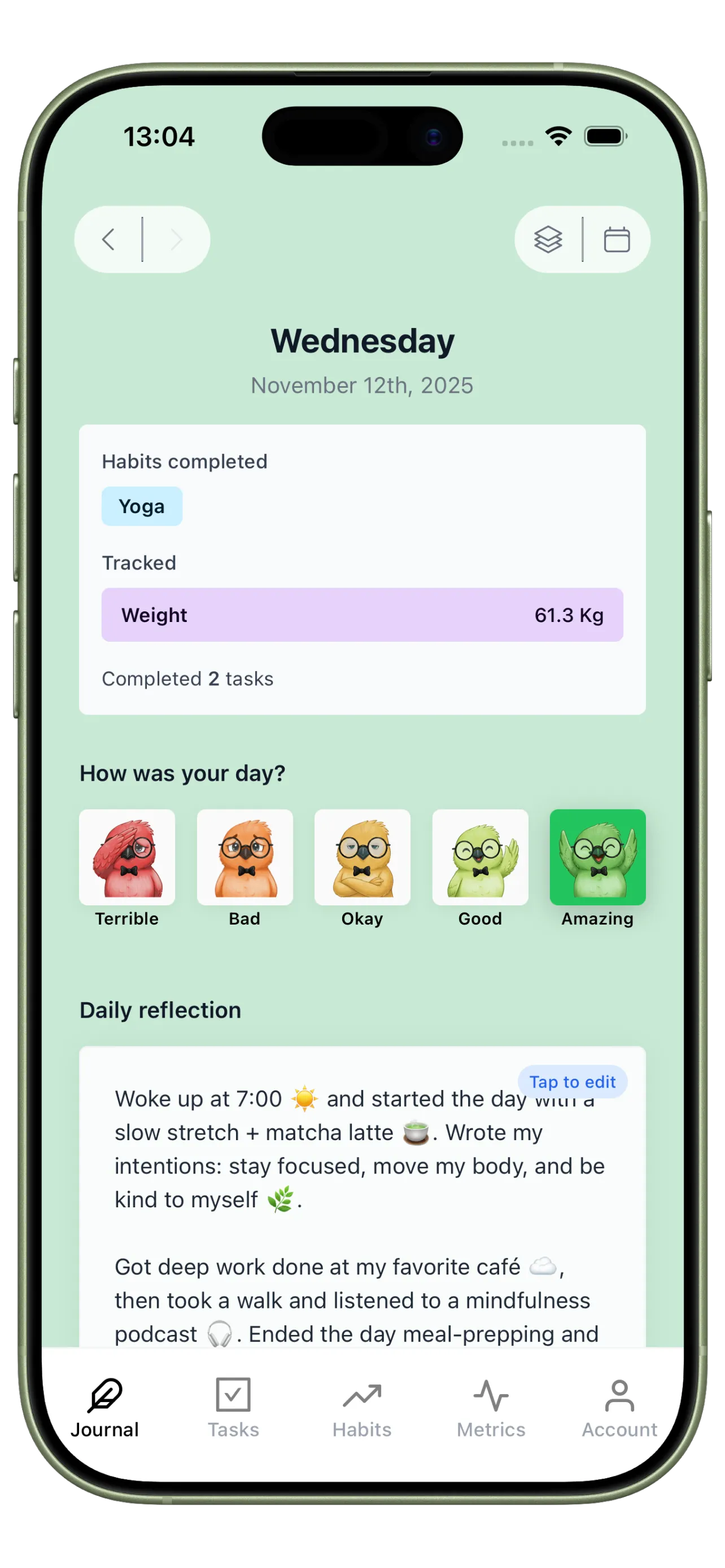
In Three Cells, this becomes practical because your journal, tasks, and habits live in one daily timeline.
People join Three Cells to get more energy, confidence, structure, and peace of mind. The app turns that intent into a simple daily system you can actually stick to.
Why AI-guided journaling works
AI-guided journaling helps by reducing decision friction. You do not have to ask, "What should I write today?" You respond to high-quality prompts that push your thinking forward.
The best prompts do three things:
- Surface the real issue behind the day.
- Separate facts from emotional narratives.
- Turn reflection into a specific next action.
That structure moves you out of passive venting and into useful problem solving.
The RAS effect: write what matters, notice what matters
Your Reticular Activating System (RAS) filters what you notice in a noisy world. When you write a clear intention, your brain starts prioritizing relevant signals.
If your morning note says, "Protect a 90-minute deep work block before noon," you are more likely to notice calendar conflicts, distractions, and opportunities that affect that goal.
This is one reason written intentions outperform mental intentions. Writing focuses attention.
Move from rumination to cognitive defusion
A common journaling mistake is rumination: replaying the same negative loop without resolution.
A better pattern is cognitive defusion. You treat thoughts as data, not truth.
Try this quick reframing format:
- Thought: "I am behind and everything is slipping."
- Data: "I missed two high-priority tasks yesterday."
- Reframe: "I need a tighter daily plan and one protected focus window."
- Action: "Start with one 45-minute block at 9:00 AM."
This shift lowers emotional overwhelm and increases execution.
See your whole day in one place

Use the 3-2-1 reflection for daily clarity
If you need a simple daily template, use this:
3things you learned today.2things that went well.1question for tomorrow.
It works because it creates both closure and direction. You process today and prepare tomorrow in the same flow.
The real advantage: pattern recognition over time
Single journal entries are useful. Long-term patterns are transformational.
When your notes, habits, and tasks are connected by date, you can spot cause-and-effect patterns such as:
- Your best focus days follow a strong evening review.
- Your mood drops when sleep tracking breaks for three days.
- You complete more meaningful work when you define one daily "must-win."
This is where a digital home base matters. Fragmented tools hide patterns. Unified data reveals them.
A 10-minute cognitive reflection workflow
Here is a workflow you can run every day:
- Review your day in Three Cells.
- Write one win, one friction point, one lesson.
- Reframe one unhelpful thought into a next step.
- Set one intention for tomorrow.
- Choose one high-impact task to start with.
Done consistently, this builds better judgment, not just better notes.
Final thought
The goal is not to journal more. The goal is to think better.
Cognitive reflection gives journaling a job: improve decisions, reduce mental noise, and make your next action obvious.
If you want sustainable personal growth, treat your journal as a feedback loop, not a scrapbook.