How to make 2026 the best year of your life
It's December. The air is getting colder, the holidays are approaching, and the collective anxiety about "what I achieved this year" is starting to set in.
You're probably telling yourself the same lie you told yourself last year: "2026 is going to be my year. I'm going to get in shape, read 50 books, double my income, and finally learn Spanish."
Spoiler alert: You probably won't.
Not because you're lazy. Not because you lack motivation. But because you're falling into the Resolution Trap. You're betting your entire future on a burst of motivation that will inevitably fizzle out by January 15th.
If you actually want 2026 to be different—if you want to look back in twelve months and legitimately not recognize the person you see in the mirror because of how much you've grown—you need to stop setting goals and start building systems.
I've spent the last decade obsessed with human performance, productivity, and the psychology of behavior change. I've tried every app, every planner, and every "life OS" template on the internet.
Here is the brutal truth I've learned: Success is boring.
It's not about 4 AM ice baths or dopamine fasts. It's about doing the same boring, effective things every single day, for a very long time.
This guide is not about "motivation." It's about engineering a life where success is the default outcome. Here is your blueprint for 2026.
See your whole day in one place

Part I: The Failure of "New Year's Resolutions"
Let's look at the data. 80% of New Year's resolutions fail by the second week of February. Why?
The Complexity Trap
We tend to overestimate what we can do in a day and underestimate what we can do in a year. So on January 1st, we commit to a routine that is sustainable for a robot, not a human.
- Meditate 30 mins
- Run 5 miles
- Read 1 hour
- Cook organic meals
- Journal 3 pages
Day 1 feels great. Day 4 is hard. Day 7, you miss one item. Day 8, you quit everything because you "failed."
The Complexity-Consistency Gap
As system complexity rises, long-term consistency plummets.
The graph above illustrates the "Complexity Trap." As the complexity of your routine increases, your consistency plummets. The "Sweet Spot" for habit formation is remarkably simple. It's better to do 5 minutes of exercise every day for a year than 2 hours of exercise for three weeks.
Motivation is a Liar
Motivation is an emotion. Like sadness or joy, it is fleeting. You cannot build a life foundation on something as unstable as an emotion. Discipline, on the other hand, is a muscle. It's reliable. But it takes time to build.
You need a system that works even when you have zero motivation. A system that works when you're tired, stressed, and busy.
Part II: The Three Pillars of a High-Performance Life
To actually change your life in 2026, you need to master three specific areas. I call these the "Three Cells" of a high-performance life.
- Reflect (Journaling)
- Act (Habits)
- Review (Metrics)
Let's break them down.
Pillar 1: Radical Self-Awareness (Journaling)
Most people sleepwalk through life. They have good days and bad days, but they never stop to ask why.
- Why did I feel anxious today?
- Why was I so productive last Tuesday?
- What actually makes me happy?
You can't improve what you don't understand.
The Solution: Micro-Journaling.
You don't need to write a novel. You don't need "Dear Diary." You just need data.
Every morning, answer three questions:
- What went well yesterday? (Gratitude/Wins)
- What could have gone better? (Improvements)
- How did I feel? (Mood score 1-5)
That's it. It takes 60 seconds.
Why this works:
- Pattern Recognition: After a month, you'll realize, "Wow, every time I scroll social media before bed, I rate my next day a 2/5."
- Course Correction: It forces you to reset every 24 hours. You can't let a bad week turn into a bad month if you're reviewing it every morning.
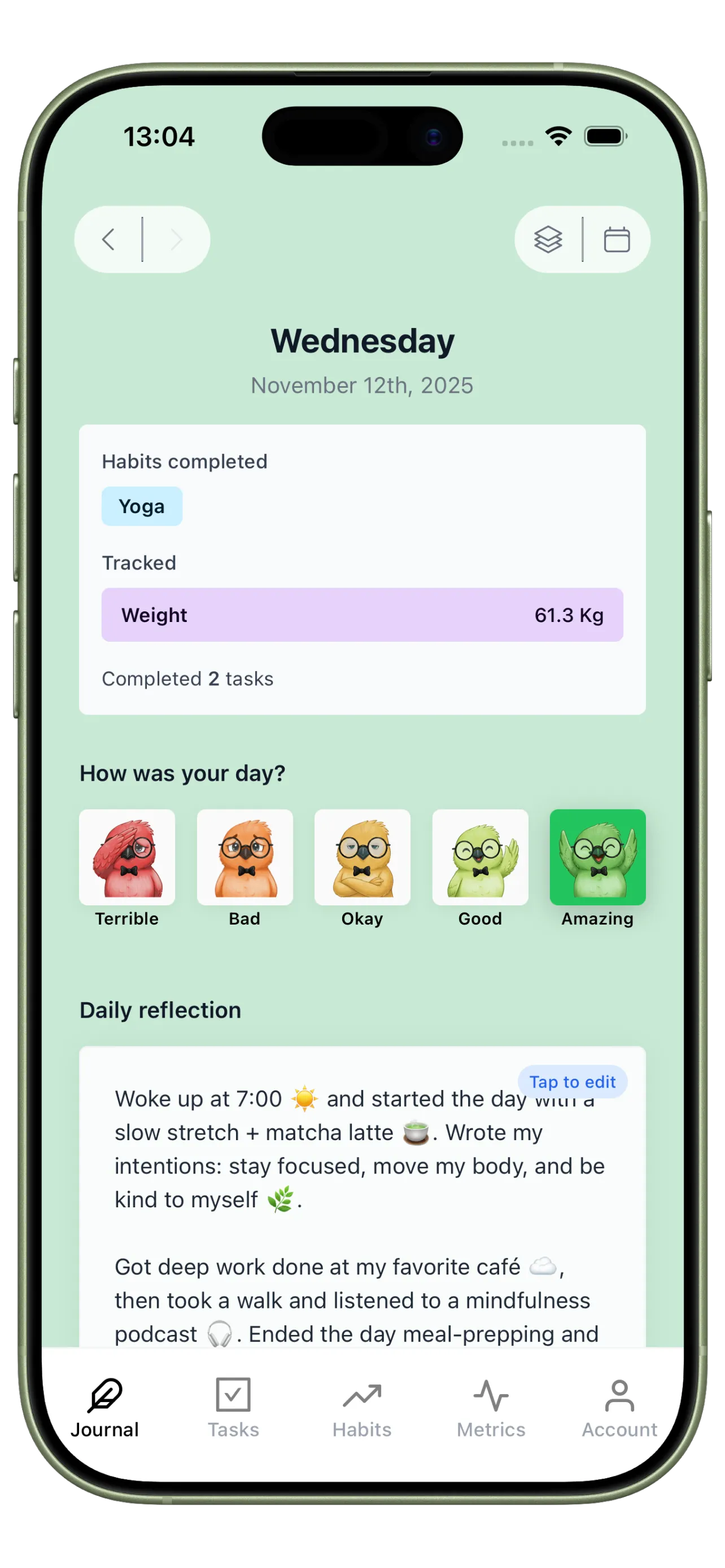
People join Three Cells to get more energy, confidence, structure, and peace of mind. The app turns that intent into a simple daily system you can actually stick to.
Pillar 2: Systems Over Goals (Habits)
James Clear, author of Atomic Habits, famously said: "You do not rise to the level of your goals. You fall to the level of your systems."
If your goal is "Write a book," that's daunting. If your system is "Write 200 words every morning while drinking coffee," that's inevitable.
The Habit Loop To build a habit that sticks, you need to hack your brain's reward system.
The Atomic Habit Loop
Habit Formed
Three Cells optimizes this loop by making the Cue obvious (one app), the Routine easy (one tap), and the Reward satisfying (heatmaps).
- Cue: Make it obvious. Put your running shoes by the door.
- Routine: Make it easy. Start with 5 minutes, not 50.
- Reward: Make it satisfying. Track it.
The Power of the Streak Don't underestimate the power of a simple checkbox. Tracking your habits provides an immediate dopamine hit. It closes the loop.
For 2026, pick 3-5 core habits max.
- Physical: Move your body (Walk, Gym, Yoga).
- Mental: Feed your mind (Read, Meditate).
- Professional: distinct work blocks (Deep Work).
Do not add more until you have a 60-day streak.
Pillar 3: Brutal Honesty (Metrics)
This is the missing piece for most people. We are terrible judges of our own behavior.
You think you've been "eating healthy," but the data says you ordered takeout 4 times last week. You think you've been "working hard," but your screen time says you spent 14 hours on TikTok.
Data doesn't lie.
To make 2026 your best year, you need to look at the scoreboard.
- What is your actual completion rate for your habits?
- What is your average mood score on days you work out vs. days you don't?
- How many books did you actually read?
Review your metrics every Sunday.
- If you hit 80%+ consistency: Keep going.
- If you hit < 50%: Your habit is too hard. Make it easier.
Part III: The Implementation Plan for 2026
Here is your step-by-step guide to setting up your 2026 system.
Week 1: The Audit
Before the new year starts, look back at 2025.
- Go through your calendar. Where did your time go?
- Go through your bank statement. Where did your money go?
- Be honest: What habits served you, and what habits held you back?
Week 2: Design Your Environment
Willpower is overrated. Environment is everything.
- Want to read more? Put a book on your pillow.
- Want to scroll less? Charge your phone in the kitchen, not the bedroom.
- Want to get fit? Prep your gym bag the night before.
Week 3: Select Your Tool Stack
You need a place to track all of this.
- Constraint: Do NOT use a complex tool.
- If you spend more time managing your productivity system than actually being productive, you have failed.
- Avoid "All-in-one" workspaces that require hours of setup.
My Recommendation: Three Cells I built Three Cells because I was tired of over-engineered Notion templates. I wanted something that forced me to focus on the essentials.
- It has the journal built-in (the 3 questions).
- It has the habit tracker built-in (with heatmaps).
- It has the metrics built-in (auto-generated graphs).
It's designed to be used in 5 minutes a day. No friction. Just focus.
Week 4: The Soft Launch
Don't wait for January 1st. Start now. Start tracking your 3 core habits today. Work out the kinks in your routine before the pressure of the "New Year" hits. By the time everyone else is hungover on January 1st, you'll already have a 2-week streak.
Summary
Making 2026 the best year of your life isn't about a grand gesture. It's about the aggregation of marginal gains.
- Stop trusting your feelings. Trust your system.
- Simplify everything. If it takes more than 5 minutes to track, you won't do it.
- Journal daily. Understand your own patterns.
- Track visually. Don't break the chain.
- Review weekly. Let data guide your decisions.
The person you want to be in 2027 is built by the actions you take today. Not the intentions you have, but the actions you actually log.
Start your streak. Don't look back.